
Blog Post
Exercise Can Help You Cope With Depression
Moving Through the Heavy Days: When Depression Feels Like More Than Just “A Bad Week”
We’ve all had days where our energy is completely gone. Maybe you slept poorly, had a stressful week at work, or just feel a bit disconnected from the world. In those moments, a solid workout, a good night’s sleep, or a long chat with a friend can be enough to reset your mood. A little bit of a low mood or mild depression is something we can usually navigate with our normal self-care routines.
But sometimes, it is more than that.
Sometimes, the heavy blanket of depression settles in so deeply that your usual habits do not seem to work anymore. The thought of exercising feels like climbing a mountain. The idea of answering a simple text message feels exhausting. When depression deepens, it does not just lower your mood. It changes the way you view your entire world, your future, and yourself.
If you are nodding along right now, I want you to hear something very clearly: Even when it feels like it, you are not stuck, and it is not hopeless.
One of the most cruel and deceptive symptoms of depression is that it creates a sense of deep hopelessness. It convinces you that nothing can be done. But that is just the depression talking. It is a symptom of an illness, not a permanent fact. There are proven techniques, practical coping skills, and professional strategies that can help you find your footing again.
Understanding the Trap of Hopelessness
To understand how to navigate deeper depression, we first have to look at how it operates. Depression thrives on a circular trap. It creates a cycle that looks a bit like this:
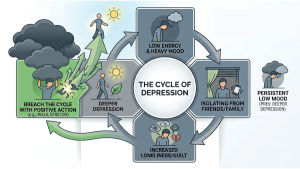
When you are in the thick of it, hopelessness acts like a pair of dark sunglasses. You look at your life, your relationships, and your future, and everything appears bleak. You might find yourself thinking, “Why bother going for a walk? It won’t fix anything,” or “I shouldn’t call my friend; I will just ruin their mood.”
It is vital to recognize that hopelessness is a physical and mental symptom, just like a cough is a symptom of a cold. It is not a true reflection of your reality. Instead, it is a sign that your brain and nervous system are overwhelmed and out of energy. Because hopelessness makes you feel powerless, the best fix is to take back your power. You do not have to change your whole life at once; you just need to start with tiny, daily steps.
Fighting the Urge to Isolate
If depression has a favorite hiding place, it is isolation.
When you feel low, your natural instinct is to pull inward. You retreat to your bedroom, close the blinds, let your phone go to voicemail, and cancel your plans. In the short term, this feels like self-protection. It feels like you are saving the little bit of energy you have left.
In reality, extreme isolation acts as fuel for depression. When you are entirely alone with your thoughts, your inner critic gets much louder. You miss out on the small things that remind your brain that a world exists outside of your pain—like the smile of a grocery clerk, the warmth of the sun, or the laughter of a loved one.
The main thing to focus on when depression deepens is to try not to isolate.
Now, this does not mean you need to force yourself to go to a crowded party or host a big dinner. When you are deeply depressed, that expectation is unrealistic and can make you feel like a failure. Instead, look for micro-connections. In psychology, we call this “opposite action”—doing the exact opposite of what the depression tells you to do.
- If the depression says: “Stay in bed all day.”
- The opposite action is: Move to the couch, or sit on the porch for ten minutes.
- If the depression says: “Ignore that text from your family.”
- The opposite action is: Send a simple emoji or write, “Thinking of you, just low energy today.”
- If the depression says: “Hide away from everyone.”
- The opposite action is: Go sit in a local coffee shop or park. You don’t even have to talk to anyone. Just being around other people in a public space can break the spell of total isolation.
The “Take a Walk” Principle (and Other Gentle Movements)
In the transcript of my recent video clip, I mentioned a simple truth: “Even if you just go out and take a walk, that’s going to help you feel a little better.”
This is not just generic advice. It is rooted in a highly effective therapy concept called Behavioral Activation. When we are depressed, we often wait until we feel like doing something before we actually do it. We think, “I will go for a walk when I have more energy.” But depression ensures that energy never arrives. Behavioral Activation flips the script: Action comes before motivation.
However, on the heaviest days, putting on your shoes and walking around the neighborhood can still feel like too big of a hurdle. If a walk is out of reach, you can scale “exercise” down to its gentlest, easiest form. Movement does not have to be strenuous or sweat-inducing to change your brain chemistry.
If you are struggling to get moving, try pairing a tiny bit of physical activity with a comforting morning routine – like having your coffee or tea on the porch, patio, or even by an open window. While you are sitting outside absorbing the morning light, you can try a few simple, seated stretches:
- Gentle Neck Rolls: Slowly drop your chin to your chest and roll your head from side to side to release the physical tension depression holds in your neck and shoulders.
- Seated Torso Twists: While holding your favorite mug, gently rotate your upper body to the left, hold it for a breath, and then rotate to the right.
- Seated Cat-Cow: Rest your hands on your knees. Inhale to lift your chest toward the sun, then exhale to round your spine and drop your head forward.
- Ankle Circles: Extend one leg out at a time and slowly circle your ankles to wake up your lower body.
Whether it is a 10-minute walk down the street or five minutes of soft chair stretches on the porch, moving your body outside accomplishes several things at the same time:
- A Natural Reset: Being outdoors introduces natural light, which helps regulate your sleep cycles and boosts your brain’s natural feel-good chemicals.
- A Sensory Break: It forces your brain to notice new surroundings—the temperature of the air, the rustle of leaves, or the smell of rain. This breaks the repetitive loop of negative thoughts.
- An Easy Win: Completing even the smallest physical action chips away at the feeling that you are completely helpless. It proves to your nervous system that you can create a positive change.
Meet yourself exactly where your energy is today. If today is only a chair-stretch day, let that be enough.
Practical Coping Skills for Heavy Days
Beyond breaking isolation and moving your body, there are specific, practical techniques you can use when you feel yourself slipping further into a depressive episode.
- The 5-4-3-2-1 Grounding Method
When depression brings anxiety or a profound sense of emptiness, grounding brings you back to the present moment. Scan your environment and identify:
- 5 things you can see (a lamp, a leaf, a book).
- 4 things you can physically feel (the fabric of your chair, your feet on the floor).
- 3 things you can hear (birds, a fan, distant traffic).
- 2 things you can smell (coffee, laundry soap).
- 1 thing you can taste (toothpaste, fresh water).
2. Practice Radical Self-Compassion
Depression makes us incredibly hard on ourselves. We judge our lack of productivity, our messy spaces, or our low mood. On heavy days, deliberately lower the bar. If you can only wash two dishes, praise yourself for those two dishes. If you only brushed your teeth but did not wash your face, that is still a victory. Treat yourself with the same gentleness you would show to a friend suffering from a physical illness.
3. Break Time Into Small Chunks
Looking at the entire week, month, or year ahead while depressed is overwhelming. It makes you feel hopeless because you wonder how you can possibly keep going. Practice breaking your time into small chunks. Do not worry about tomorrow. Can you just get through the next hour? The next fifteen minutes? Focus entirely on navigating the small block of time right in front of you.
Meeting Yourself Where You Are: The Role of Support
There is immense value in walks, grounding techniques, and fighting the urge to isolate. But it is equally important to acknowledge that sometimes, depression requires an outside team. You do not have to carry the weight of an overwhelmed mind entirely on your own shoulders, nor should you expect yourself to solve it alone.
Reaching out for professional support—whether that means talking to a doctor, joining a support group, or starting therapy—is not a sign of weakness. It is a proactive, courageous step toward reclaiming your life.
For many people navigating a deep depressive episode, the traditional logistics of getting help can ironically feel like an impossible barrier. The thought of getting dressed up, fighting traffic, sitting in a clinical waiting room, and driving home can be enough to make someone cancel an appointment before they even start.
This is where the evolution of online therapy has truly changed the landscape of mental health care.
Telehealth allows you to meet with a professional without having to overcome those exhausting physical roadblocks. It removes the pressure of “putting on a brave face” for the outside world. You can log into a secure, private session right from the comfort of your own space, wrapped in a blanket, exactly as you are. It allows you to prioritize your mental well-being while honoring your current energy levels, making support accessible when you need it most.
The Future Doesn’t Have to Be Hopeless
Depression wants you to believe that this current moment is your permanent reality. It whispers that things have always been this bad and will always remain this bad.
But it is lying to you.
Change is a quiet, step-by-step process. It often begins with the smallest possible choices—opening a window blind, stepping outside for a few minutes of fresh air, sending a single text to a loved one, or making the decision to seek guidance.
You have survived 100% of your heaviest days so far. Becoming proactive about your mental health does not mean you have to have it all figured out today; it just means being willing to take the next small step. If you feel ready to talk to someone and explore how support can help lighten the load, OK Let’s Talk! is here to offer a safe, accessible space to begin. Please reach out to schedule an online consultation whenever you are ready. You do not have to navigate this path alone.